Claude Code as a Predictor for Claude
If you want to see where Claude is headed, watch Claude Code. Features that prove themselves in the high-stakes environment of code generation have a habit of showing up later in Anthropic’s broader product lineup. Claude Code isn’t just a specialized tool. It’s a proving ground.
The clearest example is plan mode. Claude Code formalized it on October 27, 20251 — a read-only exploration phase where Claude asks clarifying questions before writing code. Instead of open-ended back-and-forth, the agent uses structured prompts to gather details: What’s the target framework? How should errors be handled? Should we preserve existing tests?
By January 2026, the same pattern appeared in Claude. When you ask it to plan travel or organize files, it uses controlled question flows with multiple-choice options — the same UX pattern from Claude Code, adapted for knowledge work. The timeline is clear: what worked in the terminal migrated to the desktop in under three months.
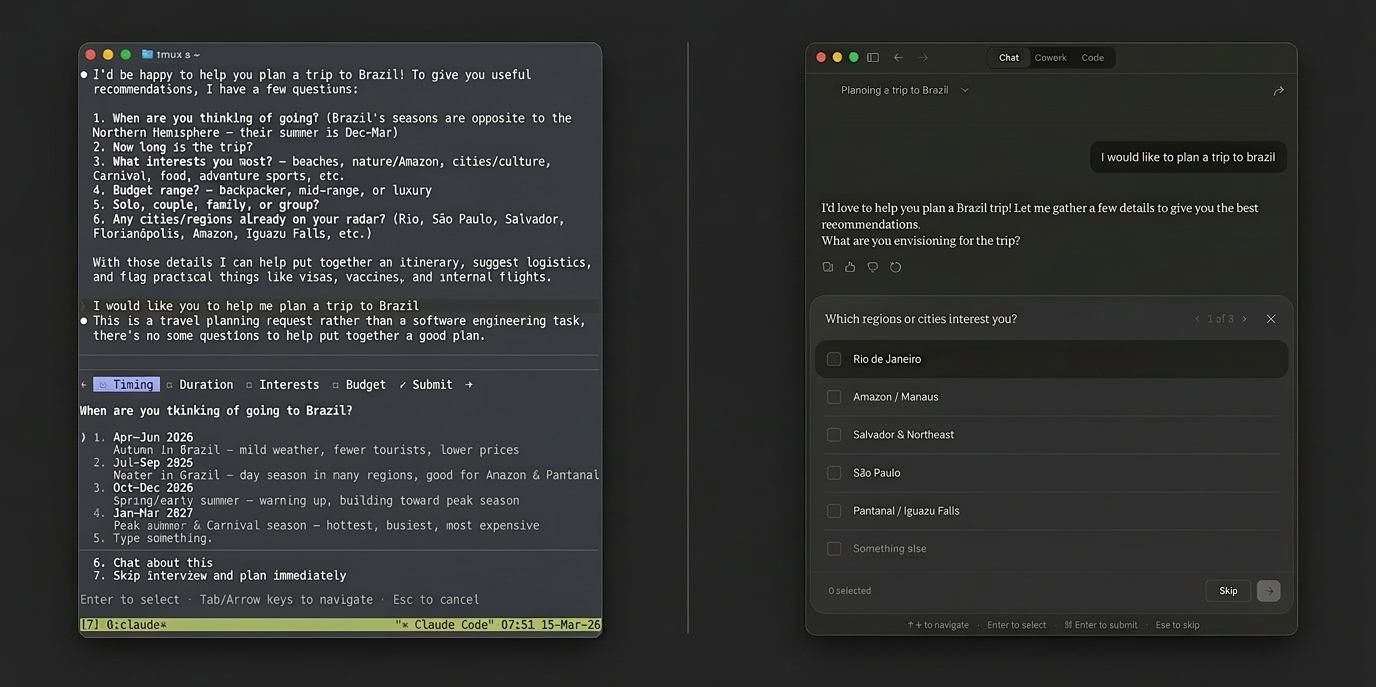
Plan mode solved a fundamental problem: reducing wasted effort. In code generation, starting without enough context leads to rewrites. The same principle applies to trip planning, research, or content creation. Controlled information gathering beats guessing. Once Claude Code validated the approach with developers, Anthropic had evidence it would work elsewhere.
Then there’s Cowork2, which is Claude Code’s architecture adapted for knowledge workers. Anthropic’s positioning is direct: Cowork brings “Claude Code’s agentic capabilities to your desktop.” Same containerized execution environment. Same clarifying questions. Same autonomous task handling. Different audience.
VentureBeat summed it up3: “Anthropic has figured out the right approach starting with the playbook that made Claude Code one of the most consequential developer tools of the past year.” Cowork isn’t a new idea — it’s the same playbook, friendlier packaging. The fact that Anthropic built it this way signals how they view Claude Code: not as a niche tool for developers, but as a UX laboratory.
The pattern extends to memory systems. Claude Code introduced persistent instruction files4 and auto-memory features throughout 2025. By March 20265, memory became available to free-tier users in mainline Claude. The API memory tool, released shortly after, uses file-based directories — the same pattern Claude Code had been running for months.
Not every Claude Code feature will migrate. But the ones that solve core UX problems — structured information gathering, persistent memory, autonomous task execution — have staying power. Features that work in the demanding environment of software development tend to work everywhere else.
Pay attention to what’s shipping in Claude Code. It’s probably coming to the rest of the product line. The timeline is short and the pattern is consistent. I personally am curious what they might do with the new agent teams feature and how that could apply more broadly to cowork.
Footnotes
-
Claude Code formalized plan mode on October 27, 2025, introducing a read-only exploration phase where Claude asks structured clarifying questions before writing code. Source: Code With Mukesh: Plan Mode in Claude Code ↩
-
Anthropic introduced Cowork as Claude Code’s architecture adapted for knowledge workers, bringing “Claude Code’s agentic capabilities to your desktop” with the same containerized execution environment and clarifying questions. Source: Anthropic: Introducing Cowork ↩
-
VentureBeat reported that “Anthropic has figured out the right approach starting with the playbook that made Claude Code one of the most consequential developer tools of the past year” when describing Cowork’s launch. Source: VentureBeat: Anthropic says Claude Code transformed programming. Now Claude Cowork is… ↩
-
Claude Code introduced persistent instruction files (CLAUDE.md) and auto-memory features throughout 2025, establishing file-based memory patterns that would later appear in mainline Claude. Source: Claude Code Docs: How Claude remembers your project ↩
-
Memory became available to free-tier users in mainline Claude in March 2026, following months of testing in Claude Code’s file-based directory system. Source: 9to5Mac: Free Claude users can now use memory and import context from rivals ↩