What Skills Will Thrive in an AI Engineering world
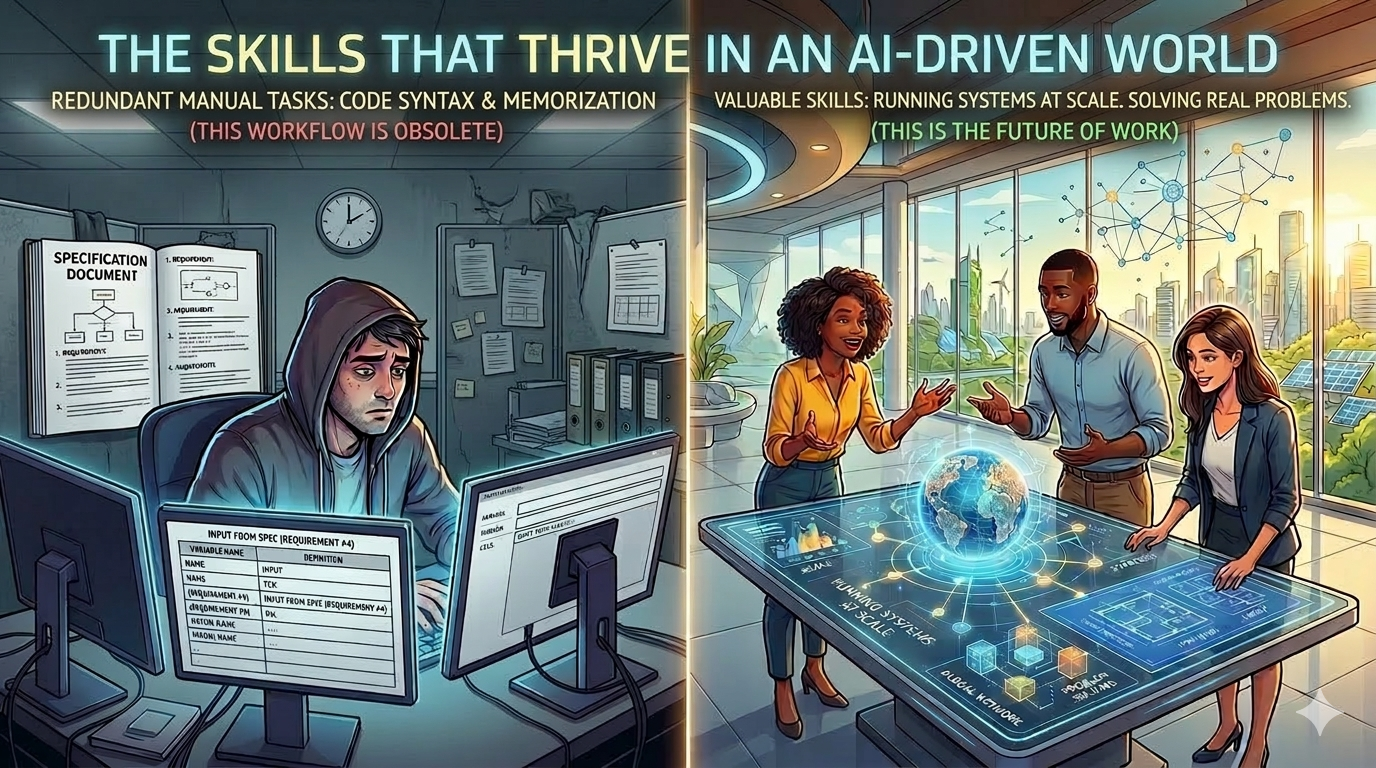
Code generation costs are approaching zero. Not zero in a literal sense—tokens cost money—but in the way that matters: dramatically cheaper than human hours. The result is an explosion of software entering the world. In February 2026 that Claude Code now authors 4% of all public GitHub commits—roughly 135,000 per day. That doubled from ~2% in January1. At current trajectory, they project 20%+ of daily commits by end of 2026.
There is a looming question in the tech industry: “what happens to developers when anyone can generate code?”
There is a real fear of job loss and obsolescence. And anyone paying attention to the news sees regular large scale layoffs2 from the tech giants and engineering job seekers will confirm that it isn’t the same industry as it was 5-10 years ago3. No wonder you seen a generation fearing being displaced by machines.
While large step-function changes in tech do have real short-term impacts the longer term consequences tend to be less dire; when spreadsheets automated accounting calculations, we didn’t get fewer accountants—we got more complex financial analysis. Automation tends to expand what’s possible and changes the value of skillsets. Cheap code generation doesn’t eliminate the need for skilled developers—it changes what skills matter. And this is especially salient when you consider how much code is about to enter the world.
So that leaves the question: What skill sets will thrive in an AI coding world?
The Operators. There’s a canyon between “I built a prototype on the weekend” and “it serves a million users reliably.” People who run large-scale production systems will be busy. Security, stability, performance at scale—these are harder problems than ever. AI can generate code, but it can’t operate resilient distributed systems. Not yet, anyway.
Organizations are discovering that moving AI from experiments to production reveals infrastructure challenges they didn’t see coming4. There is real hard work integrating AI into production systems where reliability, governance, and scale matter more than demos.
The Builders. People with ideas who always saw code as a means to an end. They cared more about the problem than the syntax. Now the barrier between idea and prototype is nearly gone. They can iterate faster, test assumptions, ship experiments. For them writing the code, building the systems was always a bottle neck, something that slowed their speed of execution down.
Agent Wranglers. The people who leaned hard into agentic workflows and turned themselves into force multipliers. They’re not writing code line by line—they’re orchestrating teams of AI agents, debugging when outputs drift, and iterating on prompts until the system produces exactly what’s needed. They are building instincts, tools and patterns around agentic development. The gap between them and developers who resisted the tools is widening fast. 2026 is the year that gap becomes permanent.
What’s Left
The gap isn’t between “coders” and “non-coders” anymore. It’s between people who understand systems and people who just write syntax. Between people who ship and people who translate.
Code generation is a lever. It amplifies what you already bring. If you bring taste, judgment, systems thinking, or relentless execution, you’ll thrive. If you brought syntax fluency and nothing else, you won’t.
The question isn’t whether you can code. It’s what you bring beyond the code.
Footnotes
-
SemiAnalysis reported in their February 2026 analysis that Claude Code now authors 4% of all public GitHub commits, approximately 135,000 per day, doubling from ~2% in January 2026. They project this will reach 20%+ of daily commits by end of 2026. Source: SemiAnalysis: Claude Code Inflection Point ↩
-
Tech sector layoffs reached approximately 150,000 positions in 2024, contributing to market uncertainty and hiring freezes across the industry. Source: Crunchbase: Tech Layoffs 2024 ↩
-
Entry-level tech job postings declined 67% between 2023 and 2024, representing a significant contraction in opportunities for junior developers entering the field. Source: Byteiota: Junior Developer Hiring Collapse ↩
-
TFiR’s 2026 analysis describes the shift from AI experimentation to production deployment: “enterprises are moving beyond hype into the hard work of integrating AI into production systems where reliability, governance, and scale matter more than demos.” Source: TFiR: AI in 2026 - Shift to Production Infrastructure ↩